
Our LCA and its environmental profile data have been finalized – co-developed with our partner Ecochain and third-party verified by NIBE. Global Warming Potential data stands at -1.75 kg CO2 eq.
BMC’s is one of the few sulfur-free and grass-extracted lignin supplier in the world. Our lignin is locally produced in Europe and follows strict processes to ensure the highest quality possible for a pure and traceable material. Our products are solely made of lignin and represent a sustainable alternative to petroleum-based products and synthetic polymers.
Our environmentally friendly products can enter an extended range of industrial applications into various markets. Our products are non-toxic, fully biobased with a favorable environmental footprint and are processed in a circular manner leaving no parts of the feedstock to waste, thereby ensuring the sustainability of the products and process.
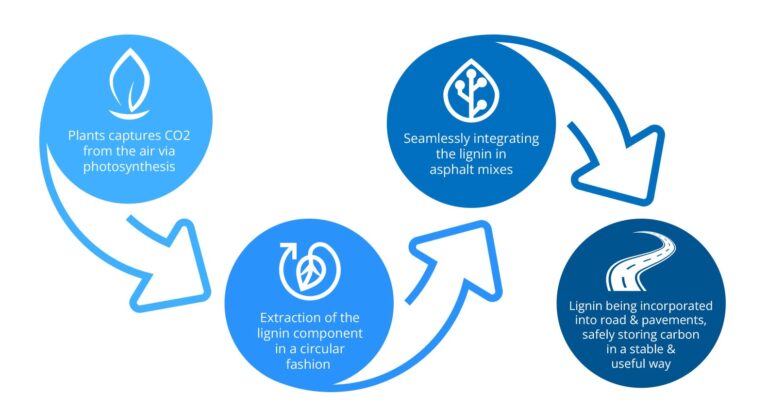
Plants naturally capture CO₂ from the atmosphere through photosynthesis and store it in their lignin. When this bio-based lignin is used in durable applications such as road construction, the biogenic carbon remains locked into the pavement while replacing fossil-based materials.
With NABi®, Bio Materials Centre enables partners to reduce the environmental footprint of their products and accelerate the transition to a circular, low-carbon economy.
The environmental performance and carbon footprint of NABi® have been independently assessed through a Life Cycle Assessment (LCA), carried out with Ecochain and externally verified by NIBE, the independent Dutch institute for the environmental assessment of construction materials.
Life Cycle Assessment performed with
Ecochain

Independently verified by
NIBE

For more information about our independently verified LCA, please contact us.
To provide the best experiences, we use technologies like cookies to store and/or access device information. Consenting to these technologies will allow us to process data such as browsing behavior or unique IDs on this site. Not consenting or withdrawing consent, may adversely affect certain features and functions.